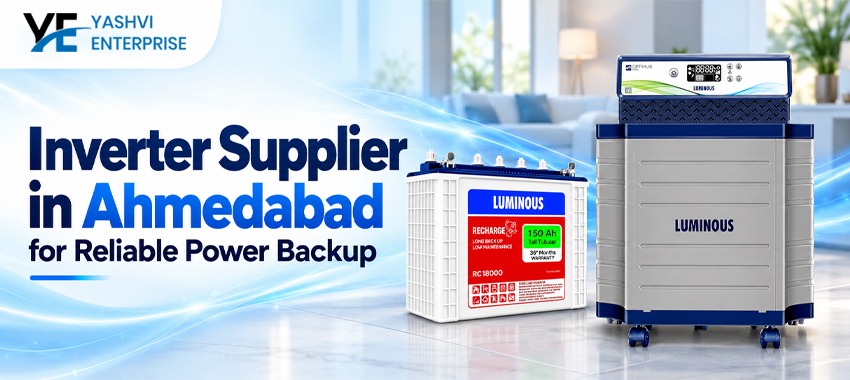
Inverter Supplier in Ahmedabad for Reliable Power Backup
As power cuts are experienced in a given locality, it hinders our daily way of life, office work, online class, online business, major household chores, and the like. An inverter can ensure that certain appliances continue to function in the event of power outages. But selecting the right system can be difficult with many aspects that influence performance including inverter capacity.
For homeowners and enterprises looking for an Inverter Supplier in Ahmedabad, knowing the above points will help you to buy the ideal one! You can provide light and fan back up at home, and computers and essential equipment at the office. Make the buying of an inverter easier!
This guide will show you what to look out for before purchasing an inverter and how to find the right inverter system to suit your needs.
Know Your Power Backup Needs
The first thing that is needed before considering the inverter and battery capacity, is what all appliances have to run during a power cut. Do you really need every appliance to run?
For a typical home, essential appliances may include:
- LED lights and ceiling fans
- Wi-Fi routers and selected electronic devices
- Computers and home-office equipment
- Other low-power appliances (if compatible)
Offices and shops could have separate priorities. A small office may require computers, networking devices and lighting to be working, whereas a shop may require a cash register and some important electronic devices.
Before choosing a product, compile a list of the appliances you want to power during a power outage. Review the appliances' power ratings and the estimated run time.
A reliable Inverter Supplier In Ahmedabad using this information will be able to guide you, rather than telling you this is the best inverter you need to buy just by looking at its capacity.
How to Choose the Right Inverter Capacity
Inverter capacity indicates the maximum electrical load the inverter can handle. It is usually specified in VA/kVA, while appliances typically state their consumption in watts.
For instance, in the case where your backup needs involve: three LED lights of 10W, two fans of 70W each, a Wi-Fi router of 10W, the resulting load will be 180W.
This is a rough calculation – not a detailed specification. The inverter has to take into account power factor, losses during conversion, and the inverter's own initial demand from other users. Motors and compressors may use several times their normal current when starting.
When evaluating an inverter, consider:
- The total load expected to operate together
- The starting requirements of connected appliances
- The inverter's rated output and power factor
- Whether additional appliances may be added later
- Compatibility with the intended battery system
Don't choose a model based solely on how many appliances it says it can support. Two homes with the same number of appliances could need vastly different amounts of power, even if they're using similar quantities of appliances.
For such we can provide you the contacts if comparing with Inverter Supplier in Ahmedabad just ask for the same on what load you are comparing and information regarding the same from the manufacturer.
Choosing the Correct Battery for Backup
The backup duration of the inverter is largely affected by the battery storage. While battery capacity is denoted in ampere hour (Ah), the backup duration is ultimately governed by load, battery health, battery efficiency, and its usable discharge capacity.
A battery with a greater capacity will, all other things being equal, backup longer, but it's not infinite. If you're operating more appliances, you'll use more power and the backup time will be shorter.
When choosing a battery, check the following:
- Capacity: Choose from a rating that aligns with the backup time you plan to have.
- Compatibility: Make sure the battery type and voltage will work with the inverter.
- Charging requirements: Review the charging specs and duration of recharge time.
- Maintenance: Understand the manufacturer's maintenance recommendations.
- Installation: Ventilation should be provided where necessary and electrical instructions should be followed.
For instance, a system with lights and fans only may operate longer than the identical system with computers and other equipment added. Actual backup time can be calculated based on the load and the battery specifications – not just a promise.
A good battery and inverter pairing can deliver significantly more usable backup than simply using one or the other without regard for how the two work together.
Understanding Different Inverter Types
It would be interesting to find different construction types of inverters.
Pure Sine Wave Inverters
Pure sine wave inverters create an output waveform appropriate for many common home appliances and electronics. They are frequently recommended for computers, TVs, networking hardware, or other equipment where the manufacturer recommends this kind of output.
Alternative Inverter Configurations
Other inverter designs might be appropriate for certain simple applications if the output and devices match. Buyers need to consider what appliances they want to run and then check their specifications; don't assume that any inverter can handle all appliances.
Also take a look at charging efficiency, features of safety you could possibly get, and what sorts of batteries will probably be supported.
When looking for an inverter, pay attention to the inverter's features, as well as other Inverter parameters. Your needs, age, and budget will all play a role in deciding which product is best for you-well, and looking good.
Things to Know When Purchasing an Inverter
Price is a deciding factor, but it should not be the only consideration for your decision. Your system should be able to provide the power you require and be reliable when you need it.
Before you buy, compare these factors:
Output capacity: Ensure that the inverter can handle the running load anticipated and associated startup requirements.
Battery compatibility: Verify the battery voltage, type, and capacity that the device supports.
Backup Duration: Calculate the approximate time required using the appliances you plan to run.
Protection features: Find out the other overload, short circuit and various other protection features that the manufacturer has included.
Warranty: Know the individual warranty on the inverter and battery as well.
Verify installation: needs, service contracts and suggested maintenance.
Future needs: Do you think you might expand your appliances or need longer backup at a later stage?
This verification allows a fair comparison between products. Checks may also help avoid the unnecessary cost of replacing an undersized system.
An experienced Inverter Supplier in Ahmedabad should be able to provide product specifications with clarity and guide you in choosing features that matter to your application.
Choosing a Supplier in Ahmedabad
Different backup requirements exist for residential localities, commercial establishments, offices and industries in Ahmedabad. A residential locality needs a simple solution catering to appliances and other needs of home owners while a hotel or a financial institution needs a solution tailored to its business hours and appliances.
The following should be provided when considering suppliers: Clear Product information, open warranty conditions, appropriate recommendations, relevant technical support. Provide information about your load and backup time so that the various options can be assessed.
Yashvi Enterprise brings inverters for customers who want to have suitable power backup options. You can see the information on the inverter supplier page which is available and compare it with your requirements.
If you are considering an Inverter Supplier in Ahmedabad, it is better to ask questions about capacity, batteries, after-installation service, and installation before making a decision. This way, you will not select an inverter just based on a low price.
Frequently Asked Questions
How do I select an inverter for my home?
Inverter size: list appliances required during power cut; total running load; starting loads. Select a suitable rating inverter and compatible battery system.
How long can the backup inverter run for?
The backup will depend on the capacity of the battery, condition of the battery, Inverter efficiency and the load connected. This can be extended by operating lower appliances during power cuts.
Can I connect a new battery to an existing inverter?
Maybe, but you'll want to verify the specs of the inverter's battery voltage, the type of battery, charging specs and the makers specs all. Match.
What should I look for when comparing inverter suppliers?
Review product specs, sizes or volume, battery compatibility, warranty, installation needs and service support. Select a supplier that can explain the options and how they relate to your actual needs.
Is a bigger inverter always better?
No. The inverter should be selected in the correct size for the load and potential future loads. Even if a larger inverter could be purchased, there is little benefit to doing so.
Conclusion
This refers to your requirement, inverter capacity, your battery and backup time estimations. The requirements can vary significantly at homes, offices and shops therefore it is necessary to evaluate the appliances used and the power consumed.
Research and select the right system by comparing specs, specifications, compatibility, as well as warranty and service options. This will save you from spending good money on a system that's not right.
Where you need an Inverter Supplier in Ahmedabad, the search begins with finding a perfect power-backup solution that will work for the load intended, as well as the operating condition and your budget.